
Many patients ask about Invisalign because they want straighter teeth.
But in clinical practice, some of the most important Invisalign cases are not about cosmetics at all.
They are about bite correction.
A misaligned bite can slowly damage teeth, strain jaw joints, and create uneven forces in the mouth. These changes often happen quietly over years, so patients do not always connect the symptoms to their bite.
Invisalign today is used not only to align teeth, but also to correct many bite problems when diagnosis and planning are done carefully.
If you are in La Jolla or the greater San Diego area and wondering whether clear aligners can fix your bite, it helps to understand what Invisalign can realistically do, where it works well, and where its limits are.
Bite Problems Are Functional, Not Just Cosmetic
A bite is the relationship between your upper and lower teeth when you close your mouth. Ideally, forces are distributed evenly so no single tooth or group of teeth takes excessive pressure.
When the bite is off, the mouth adapts. Teeth may shift, muscles may overwork, and certain teeth may wear faster than others.
Clinically, we often see bite-related issues linked to:
- Flattened or chipped teeth
- Tooth sensitivity from enamel wear
- Gum recession around overloaded teeth
- Jaw fatigue or tightness
- Minor jaw clicking in some patients
- Teeth drifting over time
Not every bite issue causes pain, but many contribute to long-term wear. That is one reason orthodontic treatment is often preventive as well as cosmetic.
How Invisalign Moves the Bite, Not Just Teeth
Invisalign works through a series of clear aligners designed from digital scans. Each aligner represents a small stage of planned movement.
For bite correction, the goal is not only straight teeth but also a coordinated relationship between arches.
This may involve:
- Vertical tooth movement (intrusion or extrusion)
- Controlled tipping or root movement
- Arch coordination
- Midline correction
- Use of elastics to guide jaw positioning
Attachments bonded to teeth allow the aligners to apply more precise forces. Without them, many bite movements would not be predictable.
This is why Invisalign results depend heavily on planning, not just wearing trays.
Invisalign for Overbite
An overbite refers to vertical overlap of the front teeth. A mild overbite is normal and even protective. Problems arise when the overlap becomes excessive.
In deeper overbites, we may see:
- Lower teeth contacting the palate
- Accelerated wear on lower incisors
- Chipping of upper front teeth
- Restricted space for proper alignment
Correcting an overbite is not simply pushing teeth back. It often requires vertical control.
Invisalign can address many overbites by:
- Intruding selected teeth
- Leveling the bite plane
- Rebalancing front-to-back forces
- Using elastics when needed
However, deep skeletal overbites related to jaw structure may not be fully corrected with aligners alone. These cases require careful discussion about realistic outcomes.
Invisalign for Underbite
An underbite is when lower teeth sit ahead of upper teeth. Some are mild and dental in nature. Others are strongly skeletal, meaning the jaw relationship plays a larger role.
Dental underbites often respond well to Invisalign through:
- Forward movement of upper teeth
- Controlled retraction of lower teeth
- Arch coordination
- Elastic wear to guide correction
But when the lower jaw is significantly prominent, aligners cannot change jaw size or position. They can improve tooth alignment and bite function, but may not fully correct the profile.
This is where honest diagnosis matters. Overselling results helps no one.
Invisalign for Crossbite
Crossbites are frequently overlooked by patients because they may not affect the front smile. But functionally, they can be significant.
A crossbite means some upper teeth bite inside the lower teeth. This can create:
- Uneven chewing forces
- Gum stress on certain teeth
- Jaw shifting during closure
- Asymmetrical wear patterns
Many crossbites are very treatable with Invisalign, especially when dental in origin.
Aligners can:
- Expand arches within biological limits
- Upright tipped teeth
- Improve symmetry
- Reduce functional shifts
Crossbite correction is often about restoring balance rather than dramatic movement.
The Role of Diagnosis in Bite Correction
Bite correction is one of the most planning-sensitive areas of Invisalign.
It requires evaluation of:
- Jaw relationships
- Facial proportions
- Tooth angulation
- Existing wear patterns
- Periodontal support
- Patient habits like clenching
A quick scan alone is not enough. The provider must interpret what movements are stable and which could relapse.
At La Jolla Dental Wellness Center, Invisalign planning for bite cases focuses on long-term function, not just short-term alignment.
Compliance Is More Critical in Bite Cases
Patients sometimes assume Invisalign is more forgiving than braces. For bite correction, the opposite can be true.
If aligners are not worn 20–22 hours per day:
- Elastics cannot do their job
- Vertical control is reduced
- Tracking issues may develop
- Treatment may extend longer
Bite correction relies on consistency. Small lapses repeated over months can affect outcomes.
Patients who do best with Invisalign are those who treat it as part of their routine, not an occasional tool.
Invisalign vs Braces for Bite Correction
Both systems can correct bites. The decision depends on complexity and patient preference.
Invisalign often works well for:
- Mild to moderate bite discrepancies
- Adults wanting a discreet option
- Patients committed to wear compliance
Braces may be preferred when:
- Movements are highly complex
- Compliance is uncertain
- Skeletal discrepancies are significant
Clear aligners are powerful, but they are not universal solutions.
Treatment Time and Patience
Bite correction usually takes longer than simple alignment.
Rough ranges:
- Mild cases: 6–12 months
- Moderate cases: 12–18 months
- Complex cases: up to 24 months
Rushing bite correction can compromise stability. Gradual, controlled movement protects roots and supporting bone.
Stability After Treatment
Finishing Invisalign is not the end of treatment. Retention is critical.
Without retainers, teeth tend to drift toward old positions. This is especially true in bite cases where forces are being rebalanced.
Long-term stability depends on:
- Wearing retainers as advised
- Maintaining oral health
- Managing grinding or clenching if present
A stable bite is a long-term investment.
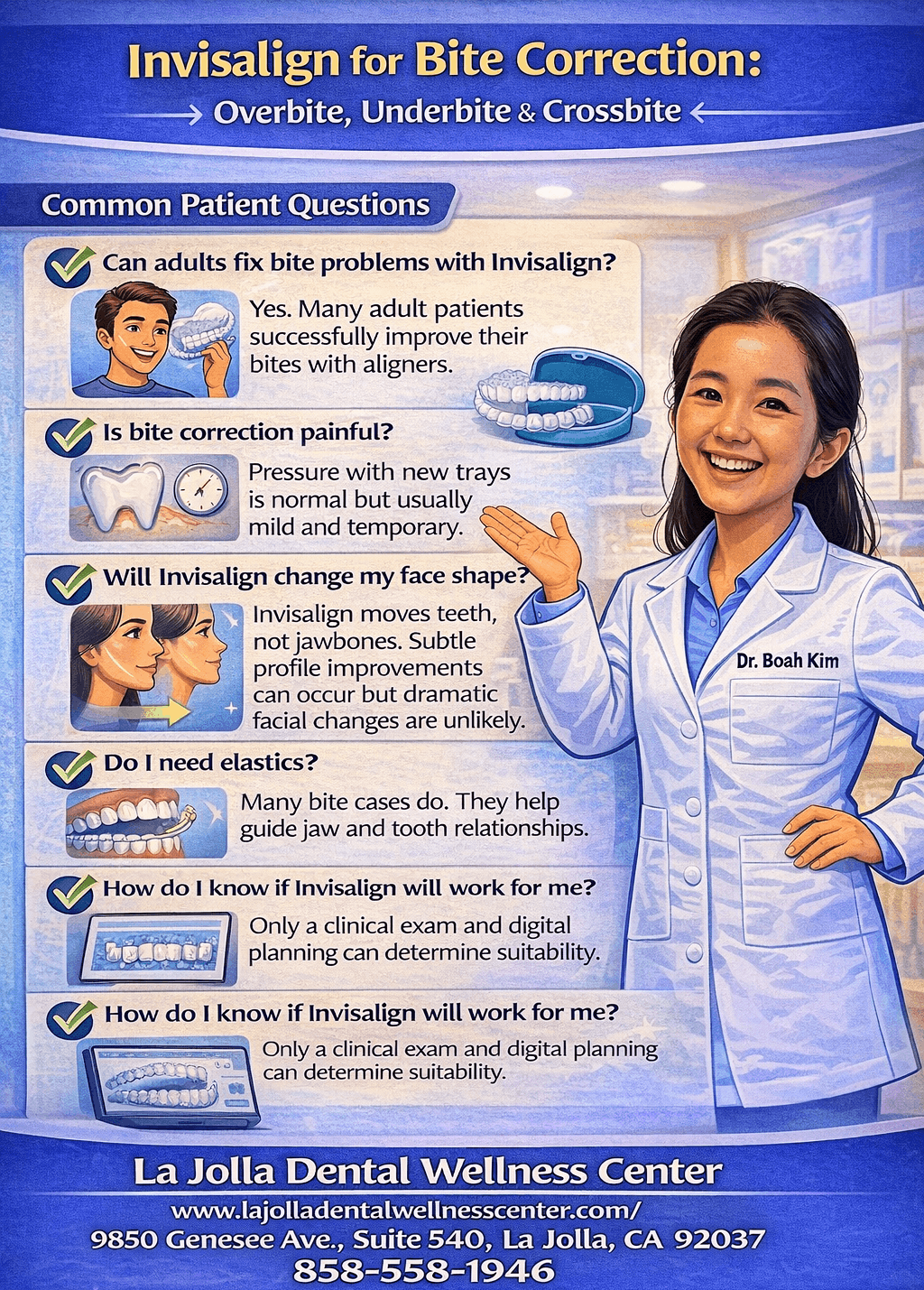
Common Patient Questions
Can adults fix bite problems with Invisalign?
Yes. Many adult patients successfully improve their bites with aligners.
Is bite correction painful?
Pressure with new trays is normal but usually mild and temporary.
Will Invisalign change my face shape?
Invisalign moves teeth, not jawbones. Subtle profile improvements can occur but dramatic facial changes are unlikely.
Do I need elastics?
Many bite cases do. They help guide jaw and tooth relationships.
How do I know if Invisalign will work for me?
Only a clinical exam and digital planning can determine suitability.
Invisalign in La Jolla and San Diego
Patients across La Jolla, Del Mar, and nearby San Diego communities often choose Invisalign because it fits professional and social lifestyles.
Clear aligners allow discreet treatment while addressing real bite concerns that affect daily function.
At La Jolla Dental Wellness Center, Invisalign care is planned with attention to both aesthetics and occlusion so results are comfortable and stable.
Get a Bite Evaluation, Not Just a Scan
If you suspect an overbite, underbite, or crossbite, guessing is not helpful. Bite issues rarely self-correct and may slowly worsen.
A proper evaluation can clarify:
- What type of bite issue you have
- Whether Invisalign is appropriate
- What results are realistic
- How long treatment may take
If you are in La Jolla or the San Diego area, scheduling an Invisalign consultation can provide personalized guidance based on your bite, not averages or marketing claims.
A well-balanced bite supports your smile for years to come.