
If you’re considering straightening your teeth, one of the first questions you’ll likely ask is this:
Are clear aligners as effective as traditional braces?
The short answer is that both systems can move teeth successfully, but they work differently. The right choice depends on the complexity of your case, your lifestyle, and your treatment goals.
For many adults in La Jolla and surrounding San Diego communities, clear aligners like Invisalign have become a popular alternative to braces. Still, traditional orthodontics remains the best option in certain clinical situations.
Here’s how they compare from a clinical standpoint.
How Clear Aligners Work
Clear aligners use a series of custom-made plastic trays that gradually shift teeth into alignment. Each set is worn for about one to two weeks before switching to the next.
The aligners apply controlled pressure to specific teeth. Modern systems use digital scans and 3D treatment planning to map out each stage of movement before treatment even begins.
Aligners must be worn about 20 to 22 hours per day for predictable results. They are removed for eating, drinking anything other than water, brushing, and flossing.
For adults in La Jolla who prefer a discreet approach to orthodontic care, clear aligners often fit well into professional and social settings.
How Traditional Braces Work
Traditional braces use metal or ceramic brackets bonded to the teeth and connected by archwires. The wire applies consistent force across the dental arch, gradually guiding teeth into position.
Because braces are fixed in place, they work continuously. Adjustments are made periodically by tightening or replacing wires.
Braces have been used for decades and remain highly effective for complex bite correction and severe alignment issues.
Clinical Differences in Tooth Movement
Both aligners and braces move teeth by applying controlled force, but there are important differences in how that force is delivered.
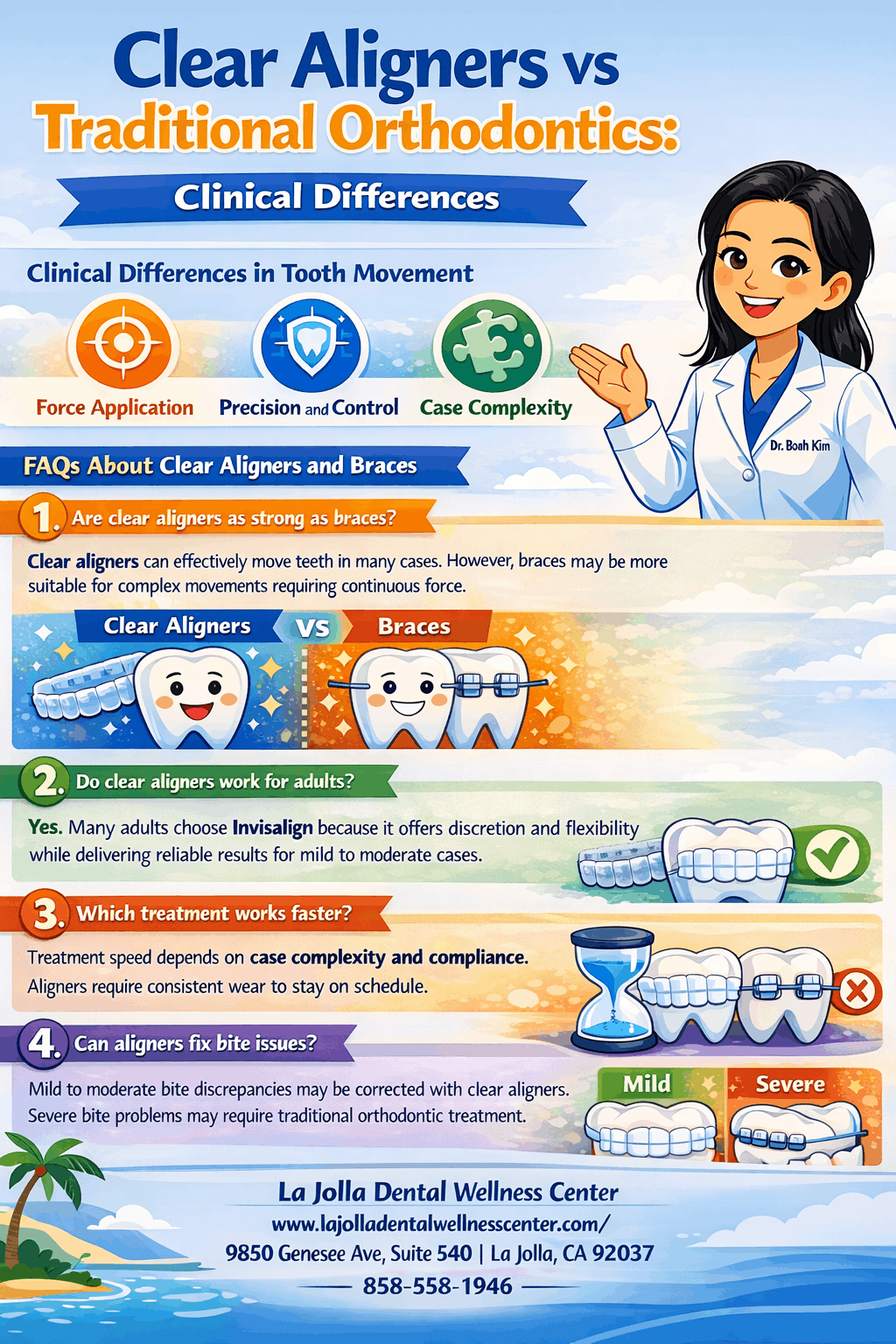
Force Application
Clear aligners apply pressure through a removable tray that fits snugly over the teeth. Small tooth-colored attachments may be bonded temporarily to help guide certain movements.
Braces use brackets and wires to generate continuous mechanical force.
Because braces are fixed, they do not depend on patient compliance. Aligners require consistent wear to be effective.
Precision and Control
Modern aligner systems rely on digital planning. Movements are mapped in advance, which allows for highly controlled sequencing.
Braces allow orthodontists to make real-time adjustments during treatment. For complex rotations, vertical movements, or significant bite correction, braces may offer more flexibility.
In many mild to moderate cases, clear aligners provide comparable precision.
Case Complexity
Clear aligners are commonly used for:
- Mild to moderate crowding
- Spacing issues
- Minor bite discrepancies
- Relapse after previous orthodontic treatment
Traditional braces are often preferred for:
- Severe crowding
- Significant overbite or underbite
- Complex jaw alignment issues
- Cases requiring tooth movement in multiple planes
An Invisalign consultation helps determine candidacy based on imaging and bite analysis.
Comfort and Lifestyle Considerations
Clinical effectiveness matters, but so does day-to-day experience.
Appearance
Clear aligners are nearly invisible. This is one of the primary reasons adults in La Jolla choose Invisalign.
Braces, even ceramic options, are more noticeable.
Oral Hygiene
Aligners are removable, making brushing and flossing easier. This reduces the risk of plaque buildup around brackets.
Braces require more careful cleaning and the use of special tools to floss around wires.
Diet
Aligners are removed for meals, so there are no food restrictions. Braces require avoiding sticky or hard foods that may damage brackets.
Treatment Timeline
Treatment length varies for both systems depending on case complexity.
Clear aligner treatment often ranges from 6 to 18 months. Braces may require a similar or slightly longer timeframe for complex cases.
Compliance significantly affects aligner timelines. If trays are not worn consistently, treatment may take longer.
Cost Considerations
The cost of clear aligners and traditional braces is often comparable, though it depends on case complexity and treatment duration.
Factors influencing cost include:
- Severity of alignment issues
- Length of treatment
- Need for refinements
- Retention phase requirements
Many practices in La Jolla offer financing options and flexible payment plans to make orthodontic treatment more manageable.
A personalized consultation provides a clearer understanding of investment and timelines.
Which Option Is More Effective?
There is no one-size-fits-all answer.
For many adults with mild to moderate alignment concerns, Invisalign can achieve excellent results with added convenience and discretion.
For complex orthodontic cases, traditional braces may offer greater control.
The key is proper diagnosis. Digital imaging and bite evaluation determine which approach is clinically appropriate.
If you’re unsure which system fits your needs, a consultation can provide clarity and prevent unnecessary delays.
FAQs About Clear Aligners and Braces
Are clear aligners as strong as braces?
Clear aligners can effectively move teeth in many cases. However, braces may be more suitable for complex movements requiring continuous force.
Do clear aligners work for adults?
Yes. Many adults choose Invisalign because it offers discretion and flexibility while delivering reliable results for mild to moderate cases.
Which treatment works faster?
Treatment speed depends on case complexity and compliance. Aligners require consistent wear to stay on schedule.
Can aligners fix bite issues?
Mild to moderate bite discrepancies may be corrected with clear aligners. Severe bite problems may require traditional orthodontic treatment.
Choosing the Right Option in La Jolla
Orthodontic treatment is both a clinical decision and a personal one.
Patients in La Jolla, UTC, and surrounding San Diego communities often prioritize discretion and convenience. Others may require more complex bite correction that traditional braces provide.
The best approach begins with a comprehensive evaluation. Digital scans, bite analysis, and a detailed discussion of your goals allow your provider to recommend the most effective option.
If you’re considering Invisalign in La Jolla, scheduling a consultation can help determine whether clear aligners are appropriate for your case. You’ll gain a clear understanding of timelines, expectations, and next steps.
Straightening your teeth is a long-term investment. Choosing the right method ensures both stability and confidence moving forward.