
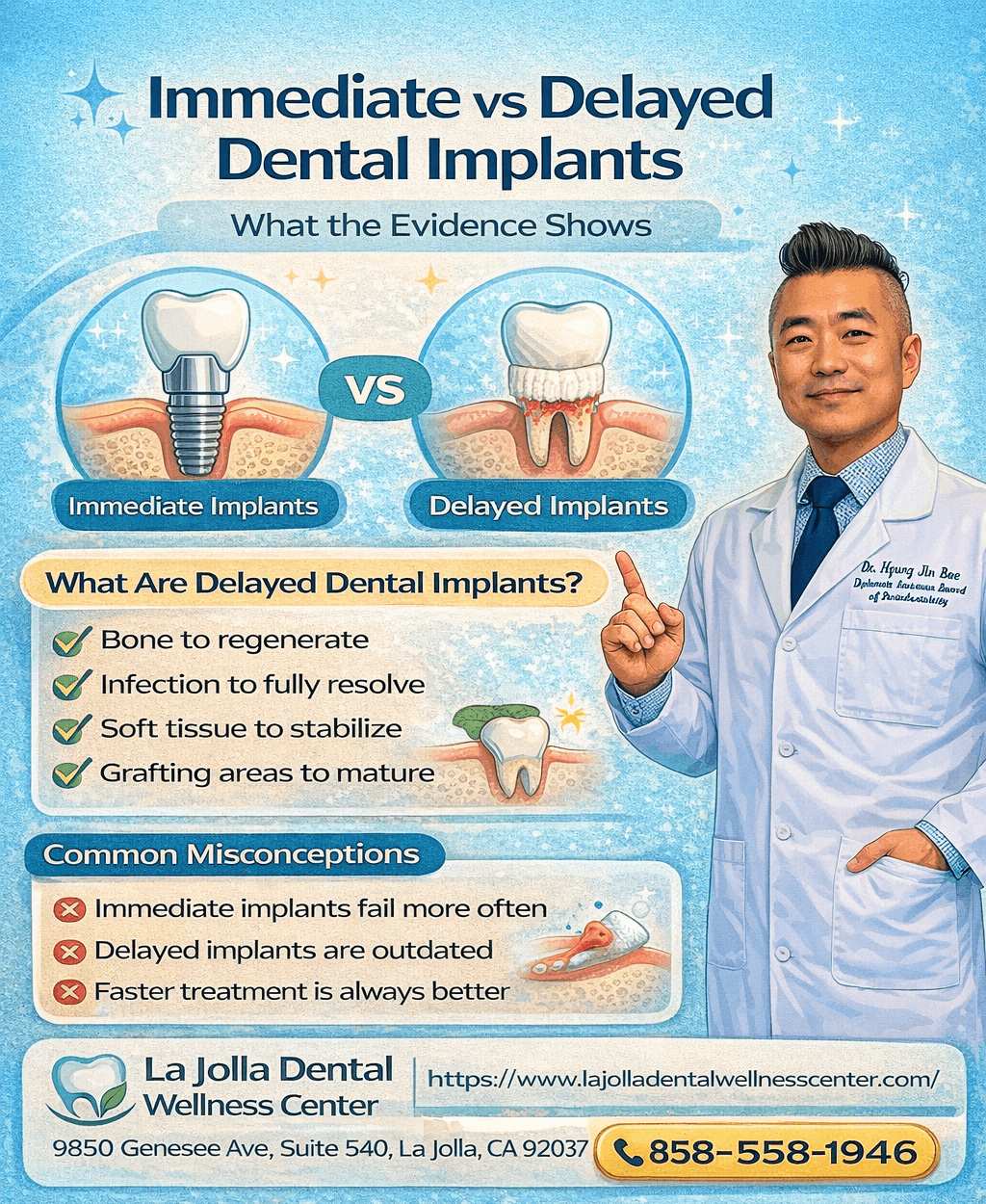
If you are considering dental implants, one of the first questions that may come up is timing.
Should an implant be placed immediately after a tooth is removed, or is it better to wait?
Many patients in La Jolla and the San Diego area are surprised to learn that both approaches are widely used in modern dentistry. Immediate and delayed implants are not competing methods. They are two evidence-based options chosen based on clinical conditions.
The best choice depends on your bone health, gum condition, infection risk, and long-term goals.
This guide explains the differences in clear, practical terms so you can understand what research and clinical experience show.
Understanding Implant Timing
Dental implants replace missing tooth roots with small titanium or ceramic posts placed in the jawbone. Over time, the bone bonds with the implant in a process called osseointegration. This creates a stable foundation for a crown or bridge.
For osseointegration to succeed, the implant must be placed in healthy bone and surrounded by stable tissue.
Timing plays a role, but it is only one part of the bigger picture. Careful diagnosis and planning matter more than speed.
What Are Immediate Dental Implants?
An immediate implant is placed at the same appointment as tooth removal.
Once the tooth is extracted, the implant is positioned in the same site. In selected cases, a temporary crown may also be placed for appearance.
Potential Advantages
- Fewer surgical visits
- Shorter overall treatment timeline
- Helps preserve jawbone structure
- May maintain natural gum contours
- Reduces time spent without a tooth
Because the implant is placed right away, the natural bone shape can sometimes be preserved more effectively.
However, immediate placement requires the right conditions. It is not suitable in every case.
What Are Delayed Dental Implants?
A delayed implant is placed after the extraction site has healed. This healing period typically ranges from 3 to 6 months.
This approach allows:
- Bone to regenerate
- Infection to fully resolve
- Soft tissue to stabilize
- Grafting areas to mature
Delayed implants have been used for decades and remain a highly predictable method.
Many dentists still prefer this approach in complex or uncertain situations.
What the Research Shows
Clinical studies over many years indicate that both immediate and delayed implants can achieve high success rates.
Research commonly reports survival rates above 90–95% for both methods when:
- Patients are carefully selected
- Proper imaging is used
- Surgical technique is sound
- Aftercare is followed
The takeaway is simple:
Timing alone does not determine success. Case selection and planning do.
When Immediate Implants May Be a Good Option
Immediate implants are often considered when conditions are favorable.
Healthy Bone Is Present
There must be enough strong bone to stabilize the implant at placement. This is called primary stability.
A 3D CBCT scan helps confirm bone quantity and density.
No Active Infection
If the tooth is removed due to fracture or structural failure without infection, immediate placement may be possible.
Active infection can increase complication risk.
Good Gum Health
Healthy gum tissue supports better healing and lowers inflammation risk.
Good General Health
Patients with good healing ability and controlled medical conditions tend to be better candidates.
High Aesthetic Priority
In the front teeth area, preserving gum shape can be important. Immediate implants may help maintain natural contours in selected cases.
When Delayed Implants May Be the Safer Choice
Delayed implants are often recommended when predictability needs to be maximized.
Infection Was Present
If a tooth had an abscess or infection, healing first is usually safer.
Bone Grafting Is Needed
When bone is too thin or weak, grafting and healing may be required before implant placement.
Gum Disease Exists
Periodontal treatment should come first to create a healthy foundation.
Complex Treatment Plans
Multiple missing teeth or full-mouth cases often benefit from staged planning.
Medical or Healing Concerns
Patients with healing challenges may do better with a conservative timeline.
Does One Method Heal Faster?
This is a common question.
Immediate implants may reduce the total timeline because extraction and placement happen together. But the implant still needs months to integrate with bone.
Delayed implants involve waiting at the start, but sometimes provide a more stable environment for healing.
So the answer is not simply “immediate is faster.”
It depends on the individual case.
Aesthetic Considerations
Cosmetic outcomes are especially important in visible areas.
Immediate implants can help preserve gum contours, but only when tissue quality is good.
If the gums are thin or damaged, delayed placement may actually produce more natural-looking results.
Good cosmetic outcomes depend on planning, not just timing.
Factors That Influence Timing Decisions
Dentists evaluate several factors before recommending timing.
These include:
- Bone density and volume
- Gum thickness
- Infection history
- Smoking habits
- Diabetes control
- Bite forces
- Teeth grinding
- Oral hygiene habits
Each factor affects healing and long-term stability.
This is why two patients with similar missing teeth may receive different recommendations.
Patient Preferences Also Matter
Some patients want the shortest timeline possible. Others prefer the most cautious and predictable route.
Both perspectives are valid.
A good treatment plan balances clinical needs with personal priorities.
At La Jolla Dental Wellness Center, implant timing is determined after careful imaging and conversation, not a one-size-fits-all formula.
Immediate vs Delayed: Simple Comparison
Immediate Implants
- Placed same day as extraction
- Fewer surgical visits
- Shorter overall timeline
- Requires strong bone and healthy tissue
- Not ideal for infection cases
Delayed Implants
- Placed after healing
- Allows infection resolution
- Good for grafting cases
- Often used in complex situations
- Highly predictable
Both approaches can be successful when chosen correctly.
Common Misconceptions
“Immediate implants fail more often.”
When placed in the right conditions, success rates are comparable.
“Delayed implants are outdated.”
Delayed placement remains a trusted and evidence-supported method.
“Faster treatment is always better.”
The safest and most predictable plan is more important than speed.
FAQs About Implant Timing
Can I get a tooth removed and an implant the same day?
Sometimes. It depends on bone support, infection status, and stability.
Is one option more painful?
Comfort levels are similar. Post-surgical care plays a bigger role.
Do immediate implants cost more?
Costs depend on grafting, restorations, and case complexity.
Which option lasts longer?
Longevity depends more on planning, health, and maintenance than timing.
How do I know which is right for me?
Only a clinical exam and 3D imaging can determine this safely.
Why a Personalized Evaluation Matters
Online articles can explain concepts, but they cannot examine your bone or gums.
A proper implant evaluation usually includes:
- 3D CBCT imaging
- Bone assessment
- Gum health review
- Medical history discussion
- Bite analysis
- Goal and expectation planning
This ensures safe and realistic treatment.
Patients visiting La Jolla Dental Wellness Center receive implant planning focused on long-term outcomes, not rushed decisions.
Dental Implants in La Jolla and San Diego
Many patients across La Jolla, San Diego, Del Mar, and nearby communities choose implants to restore function and confidence.
Both immediate and delayed implants can work very well when carefully planned.
The key is thoughtful diagnosis and honest discussion.
Get Clear Guidance for Your Situation
If you are facing a tooth extraction or thinking about implants, timing matters. But the right timing is personal.
A professional evaluation can show what is safest and most effective for you.
If you are in La Jolla or the greater San Diego area, schedule a consultation to explore your options and receive guidance tailored to your needs.
A well-planned implant today can support your oral health for many years.